How to Read a Water Test Without Getting Sold Something You Do Not Need
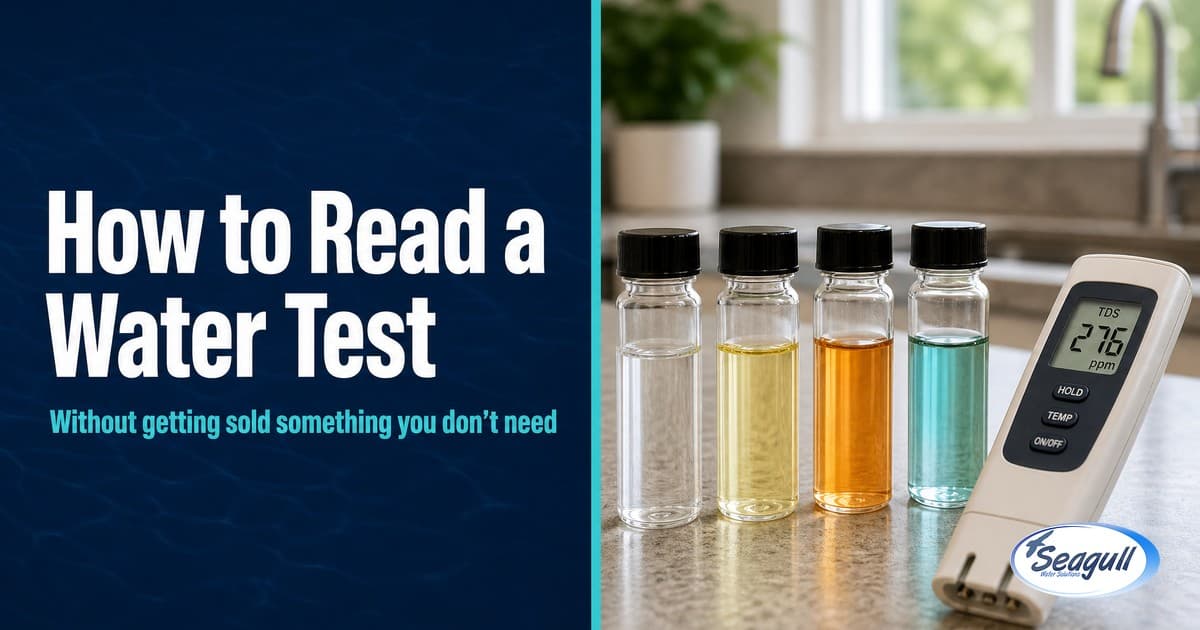
Short answer: a trustworthy water test gives you specific, measurable numbers, like a TDS reading in parts per million or a hardness level, and explains what each one means before anyone talks about equipment. The method doesn't have to be a certified lab to be legitimate. What matters is whether you get real numbers and a clear explanation first, or a dramatic reveal and a same-day quote with nothing to check it against.
What a Trustworthy Water Test Actually Shows You
A real test measures something specific: total dissolved solids (TDS) in parts per million, hardness in grains per gallon, the presence of chlorine, iron, or sulfur. These are measurable, not just a visual impression. A TDS reading of 300 ppm is a number you can look up and understand. A cloudy glass of water with no number attached is not.
Numbers First, Equipment Second
The order matters more than the method. Whether the test uses a digital meter, a reactive kit, or a certified lab, the same rule applies: you should see and understand the actual result before anyone recommends a system. If a visit jumps straight from "look how bad this is" to a quote, without ever showing you a number tied to a specific problem, that's the part worth noticing, not the tool being used.
Which Tests Are Usually Field Tests, and Which Need a Lab
Most day-to-day water problems, like hardness, chlorine, iron, or sulfur odor, can be reasonably identified on the spot with the right equipment and a clear explanation of the reading. Some things genuinely require a certified lab, most commonly bacteria testing for private wells, which typically takes 24 to 48 hours and costs in the range of $60 to $90 through an accredited lab. Neither approach is automatically better. What matters is that you're told which one you're getting and why.
Questions to Ask Before Accepting Any Quote
Before you agree to anything, it's reasonable to ask:
- What is the actual number or reading for my water, and what does it mean?
- Which specific result is this recommendation solving for?
- Is this a field test or does it need to go to a certified lab, and why?
- What happens if I say I need time to think about it?
A straightforward answer to all four is a good sign. Pressure to decide on the spot, or a recommendation with no result to point back to, is worth noticing.
Where to Find Your Water's Real Numbers
If you're on city water, your utility is required to publish an annual water quality report, often called a Consumer Confidence Report (CCR). It lists what's actually measured in your local supply, straight from the source. If you're on a private well, city reports won't apply to you, since a well isn't tested by a municipality, and a proper well test should walk through flow rate, hardness, iron, pH, and sulfur, with a certified lab used for anything that needs one, like bacteria. If you're in the Seminole County area, our local water guide breaks down what typically shows up in the area's city and well water.
Frequently Asked Questions
No. Many water problems, like hardness, chlorine, or iron, can be reliably identified with the right field equipment and a clear explanation of the reading. Certified labs are typically used for specific cases, like bacteria testing on private wells.